
Elucidation of endotypes and mechanisms of immune-mediated diseases through proteome analysis
Abstract
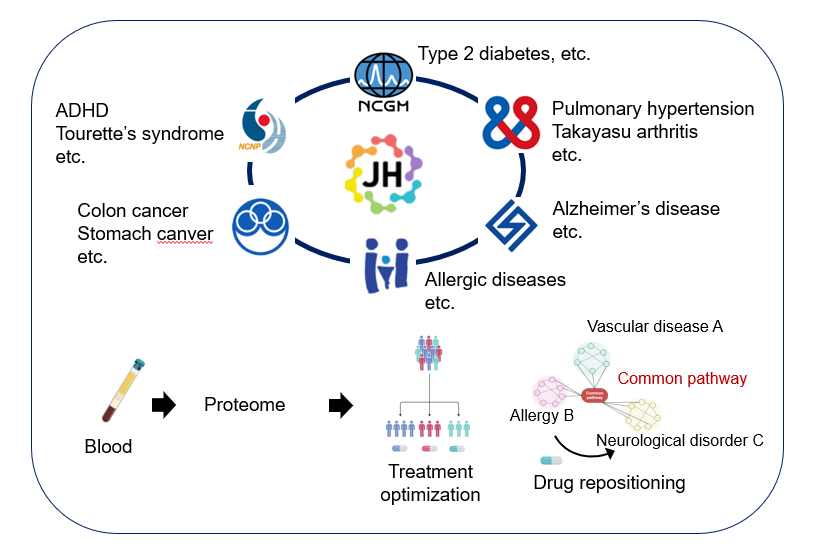
In recent years, the remarkable advancements in pharmaceutical development technologies have led to the practical application of novel drugs, such as molecularly targeted therapies, which are designed to act on specific molecules implicated in disease pathogenesis across various fields. However, it is becoming evident that even among patients diagnosed with the same disease, the efficacy of such targeted therapies varies significantly, with some patients responding favorably to the treatment while others exhibit poor or no response. These findings suggest that the underlying pathophysiological mechanisms of diseases, traditionally considered singular entities, may differ among individual patients. Therefore, developing biomarkers capable of predicting the effectiveness of therapeutic agents for individual patients is needed. This study aims to identify biomarkers by conducting a comprehensive analysis of proteins in the blood, focusing on immune-mediated diseases. Furthermore, it has been suggested that diseases previously regarded as distinct entities may share common pathological mechanisms. To address this, our study will also compare different diseases analyzed by each National Center, exploring the presence of shared pathological mechanisms. If commonalities in pathophysiology across different diseases can be identified, it will lead to the drug repositioning from one disease to another disease. By leveraging the collaborative strengths and specialized expertise of six National Centers, we aim to contribute to developing innovative diagnostic and therapeutic approaches.
Image
Perspectives
Through this study, if biomarkers that can be utilized to predict therapeutic efficacy are identified, it may become possible in the future to provide optimal treatments tailored to individual patients. Additionally, drugs already in use as treatments for one disease may have the potential to be applied to other diseases as well.
Comments from principal researcher
National Research Institute for Child Health and Development, Department of Allergy and Clinical Immunology, Hideaki Morita

Advancements in medical technology have made various treatment options available; however, it often takes considerable time to identify the most suitable therapy for each individual patient. Through this study, we hope to contribute, even in a small way, to the selection of optimal treatments for individual patients. Additionally, if drugs already in clinical use for specific diseases are found to be applicable to other diseases, it could lead to rapid clinical implementation, bringing significant benefits to patient care.
Shared Researchers
National Cerebral and Cardiovascular Center
Department of Vascular Physiology, Yoshikazu Nakaoka
National Center of Neurology and Psychiatry
Department of Developmental Disorders, Takashi Okada
National Center for Global Health and Medicine
Diabetes Research Center, Ryotaro Bouchi
National Center for Geriatrics and Gerontology
Department of Psychiatry, Fumihiko Yasuno
National Cancer Center Research Institute
Department of Integrative Oncology, Yusuke Yamamoto