
A Multicenter Study on the Infection Status and Presenteeism of National Center Staff in the Late Phase of the COVID-19 Pandemic
Abstract
Despite the designation of the novel coronavirus infection (COVID-19) as Category 5 under the Infectious Disease Control Law in May 2023, epidemics caused by variants with robust immune evasion capabilities and high infectivity have persisted since then. The number of patients is now monitored at designated medical facilities at fixed points, which makes it challenging to accurately ascertain the actual state of infection. While the risk of severe illness is minimal among the working population, concerns persist regarding the potential decline in quality of life and work performance associated with the illness and its sequelae. Additionally, there is a growing recognition of the need to address the potential decline in hospital functions in the event of a cluster outbreak. Furthermore, the winter season brings an additional challenge in the form of seasonal infectious disease outbreaks, such as influenza. With the full implementation of reforms to the physician work model anticipated in FY2024, there is a pressing need for scientific evidence to inform the practices of healthcare workers during infectious disease outbreaks.
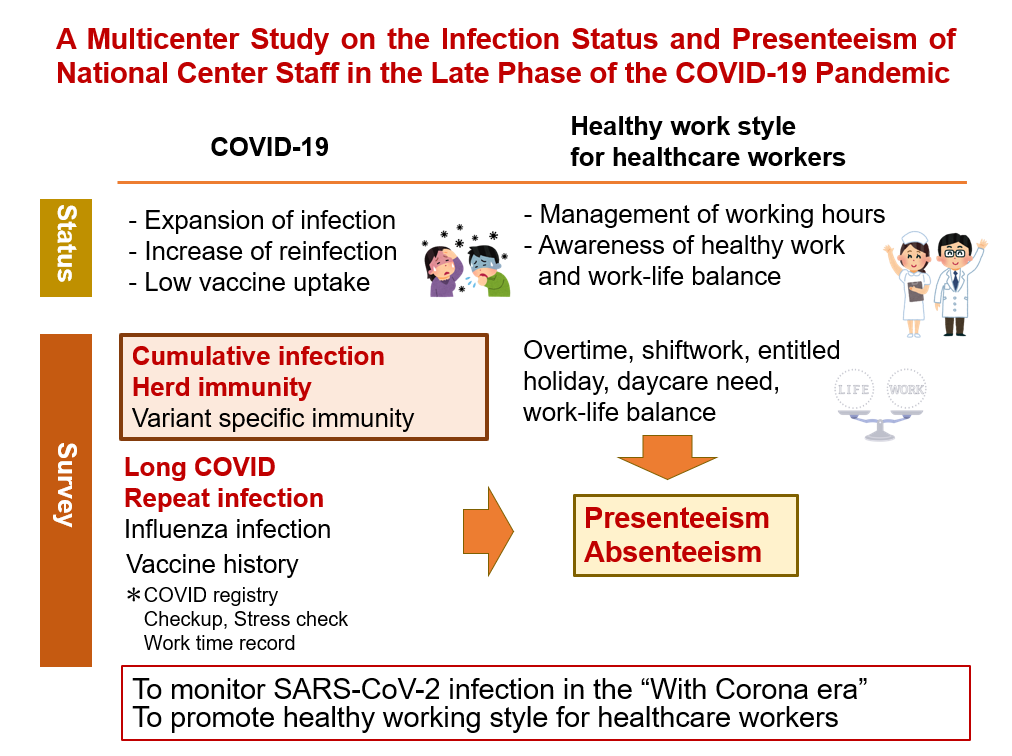
In light of these considerations, this research group is conducting an epidemiological survey of six national center employees to address the following key research questions:
- To monitor the cumulative infection and reinfection rates of SARS-CoV-2, including undiagnosed cases, in relation to the background factors of the subjects.
- To monitor the trends of population immunity against SARS-CoV-2 and examine the factors defining individual differences in immunity, with a particular focus on hybrid immunity resulting from both natural infection and vaccination.
- To clarify the correlation between the antibody titer (including neutralizing antibodies) and the risk of infection with new variants.
- To elucidate the risk and determinants of sequelae associated with both SARS-CoV-2 and influenza.
- To assess presenteeism (poor work performance) and absenteeism during the so-called "With Corona" era and their determinants.
Image
Perspectives
- The objective evaluation of the cumulative infection rate of SARS-CoV-2 and population immunity on a large scale through antibody survey data will demonstrate the extent of infection following the transition to category 5. Furthermore, it will provide fundamental epidemiological data for the implementation of effective prevention measures against the spread of the virus.
- Should the relationship between antibody titer and infection risk be elucidated, the resulting data would prove invaluable in determining the preventive medical significance of measuring antibodies and the target and timing of vaccination.
- Elucidating the actual status of sequelae of novel coronavirus infection and its determinants will provide information on the prevention and care needs for sequelae.
- By clarifying the actual conditions and determinants of presenteeism and absenteeism in the so-called "WITH CORONA" period, we can contribute to promoting the work style of healthcare workers.
Comments from principal researcher
Tetsuya Mizoue, Director, Department of Epidemiology and Prevention, Center for Clinical Sciences, National Center for Global Health and Medicine

The recent emergence of COVID-19 has had a profound impact on global health and well-being. Despite the virus's designation as a Category 5 infectious disease, the threat persists. This study, conducted at six national centers, aims to assist healthcare professionals in adopting healthier work practices while confronting infectious diseases during the "With Corona" era. To this end, the study examines trends in infection status, health status, and work performance, as well as the factors associated with these outcomes.
Shared Researchers
National Center for Global Health and Medicine
- Department of Epidemiology and Prevention, Center for Clinical Sciences: Shohei Yamamoto
National Cancer Center
- Division of Prevention, Institute for Cancer Control: Manami Inoue, Mayo Hirabayashi
- Division of Cohort Research, Institute for Cancer Control: Rieko Kanehara
National Center for Child Health and Development
- Women's Internal Medicine, Women's Health Center: Koushi Yamaguchi
National Center of Neurology and Psychiatry
- Clinical Research & Education Promotion Division, Kazuyoshi Takeda
National Center for Geriatrics and Gerontology
- Biosafety Administration Division: Akihiko Nishikimi
National Cerebral and Cardiovascular Center
- Department of Preventive Medicine and Epidemiology, Research Institute: Kunihiro Nishimura, Soshiro Ogata
- Department of Biostatistics, Research Institute: Kanako Teramoto