
Investigation of Fall Risk Reduction in Healthcare Settings: A Comparative Study Across Facilities and Analysis of Disease-Specific Factors
Abstract
The percentage of elderly people in Japan continues to increase, with a 2020 survey indicating an aging population rate of 28.8%. The incidence of falls in hospitals is increasing across all age groups, leading to prolonged hospitalization, complications, and a decline in functional abilities. Additionally, the experience of falling can instill a fear of falling, potentially resulting in a " vicious circle," which narrows the range of activities and contributes to a decline in both physical and mental function. Falls during hospitalization not only diminish quality of life but also increase physical and mental burdens as well as medical costs. Furthermore, there have been instances in which hospitals have been ordered to pay compensation, highlighting this as a significant social issue.
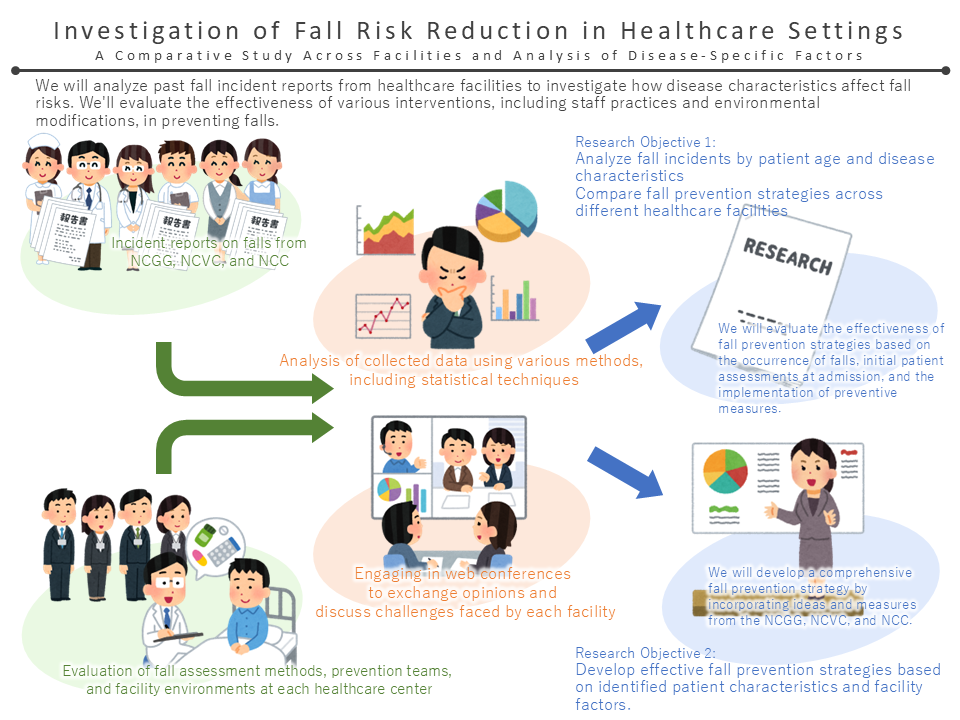
This study aimed to develop effective countermeasures to prevent falls in the elderly and investigate incident reports at three medical facilities. Internal factors, such as patient age and disease, and external factors, such as facility structure and bedside environment, were analyzed to compare differences and similarities between facilities. Additionally, we will examine each facility's approach to fall prevention and the conditions and environments in which falls occur most frequently.
Multicenter studies such as this are expected to enhance the safety of hospitalization for the elderly and improve the quality of medical care, as they allow for the collection of a wide range of data in a short period of time and enable the examination of fall prevention measures from various perspectives. The findings will also educate the medical staff and improve patient care. We aim to contribute to the society by formulating effective fall prevention measures.
Perspectives
The number of falls is expected to decrease when fall prevention measures are reviewed and refined. Throughout the survey, we anticipated revealing characteristics such as the locations and times when falls are most likely to occur, and the illnesses and ages of the patients involved.
Furthermore, more specific preventive measures can be proposed by analyzing the results based on characteristics, such as the patient population of each hospital. As accidents involving falls and tumbles decrease, hospitalized patients can spend their hospital stay with greater peace of mind. This virtuous cycle of hospitalization can also lead to shorter hospital stays and prevent treatment costs associated with falls owing to reduced physical and mental burdens.
There have not yet been many studies in Japan, such as this one, where multiple hospitals cooperate to investigate falls and tumbles. Therefore, publishing the results of this study in a paper or another publication would serve as a useful reference for other hospitals looking to conduct similar research. Additionally, if further studies are needed to confirm the effectiveness of the newly devised preventive measures, the results of this study can be utilized as foundational data. Our contributions can enhance patient safety as well as the quality and efficiency of medical care.
Comments from principal researcher
Kenichiro Maki(Chief Occupational Therapist, Department of Rehabilitation, National Center for Geriatrics and Gerontology)
Fractures due to falls during hospitalization are an issue that must be prevented. The mechanisms underlying falls are still not fully understood, making this study crucial for providing safe and secure medical care. We will explore ways to prevent falls not only by increasing manpower but also through innovative working methods and environmental improvements. In addition to developing preventive measures that can be used across various medical facilities, we hope to disseminate knowledge on fall prevention that will benefit young medical professionals.
Shared Researchers
Noboru Hyodo(National Cerebral and Cardiovascular Center)
Shota Yokota(National Cancer Center)
Koki Kawamura(National Center for Geriatrics and Gerontology)
Tomoyasu Kinoshita(National Center for Geriatrics and Gerontology)