
Exploration of novel drug targets for Alzheimer's disease by the functional analysis of patient-derived mutant SHARPIN
Abstract
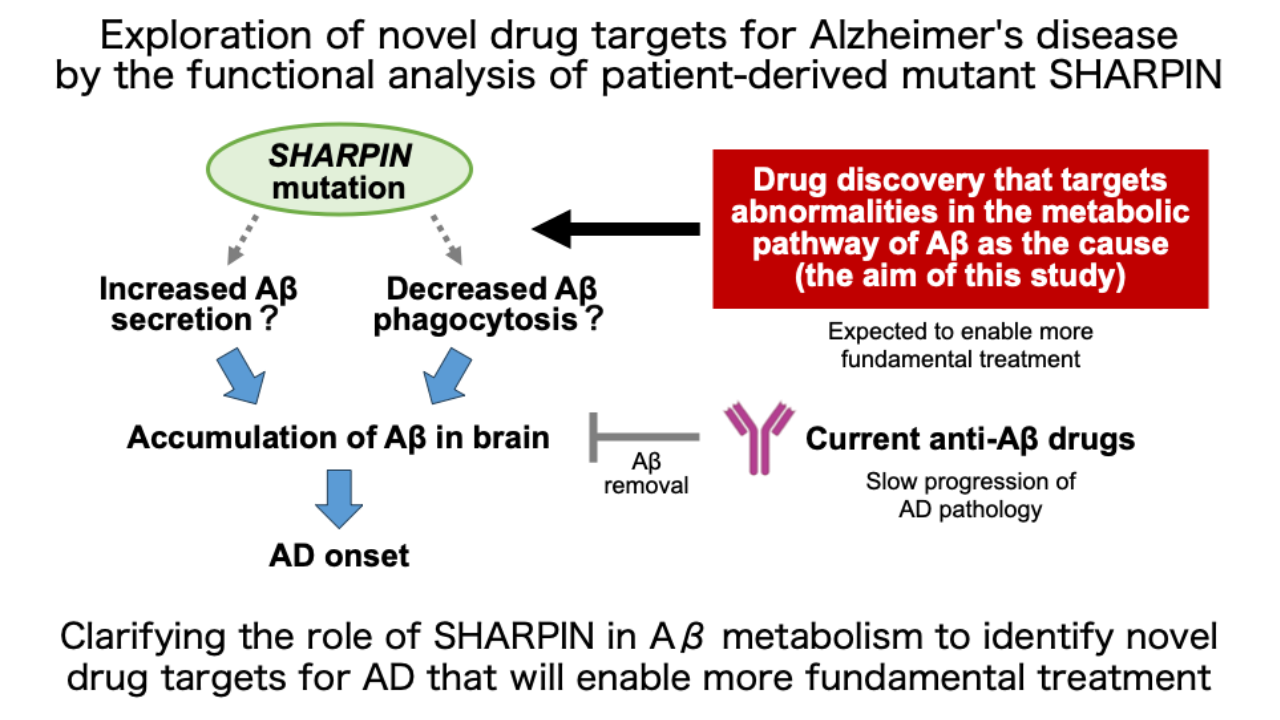
In Japan, a super-aged society, the increase in the number of dementia patients, as typified by Alzheimer's disease (AD), has become a serious social problem. Recently approved drugs targeting amyloid-β (Aβ), which accumulates in the brain and is a typical pathological condition of AD, have been used for the treatment of AD. Unfortunately, although they slow the progression of the disease, they have failed to recover the cognitive impairment. These anti-Aβ drugs only remove accumulated Aβ and do not act on the cause of Aβ accumulation. Therefore, the development of drugs that target the metabolic pathway of Aβ is expected to lead to a fundamental treatment of AD.
We have been searching for AD-related genetic factors that are unique to Japanese people. We have analyzed the genomes of more than 20,000 Japanese population, including AD patients, and we are leading the world in identifying two missense variants (G186R and R274W) in SHARPIN as novel risk factors for AD. Recently, we found that Aβ secretion is increased in AD-model cells by the knock-in of the G186R mutation. On the other hand, other research groups have reported that knockdown of SHARPIN reduces Aβ phagocytosis in macrophages, suggesting an essential role of SHARPIN in the metabolic pathway of Aβ. In this study, we aim to elucidate the mechanisms by which SHARPIN mutations found in AD patients lead to disease onset, especially the role of SHARPIN in Aβ metabolism, and to discover novel drug targets for AD. To this end, we will use microglia isolated from the SHARPIN G186R knock-in mice to elucidate the effect of the mutation on Aβ metabolism-related pathways by RNA-Seq analysis. By clarifying the role of SHARPIN in Aβ metabolism through this study, we expect to find drug targets that will enable more fundamental AD treatment.
Perspectives
- Investigating the effect of the SHARPIN G186R mutation, found in Japanese AD patients, on microglial Aβ phagocytosis may provide an essential clue to clarify the role of SHARPIN in AD pathogenesis.
- While recently approved anti-Aβ antibody drugs directly target Aβ accumulation in the brain, they do not act on the cause of Aβ accumulation. Clarifying the role of SHARPIN in Aβ metabolism, which is expected to be obtained in this study, will identify novel drug targets for AD that will enable more fundamental treatment.
- The findings of this study might become the basis for future drug development research on AD and related dementia.
Comments from principal researcher
Yuya Asanomi (Division of Genomic Medicine, Medical Genome Center, Research Institute, National Center for Geriatrics and Gerontology; Research fellow)
The increase in the number of dementia patients due to a super-aged society is a serious social problem that affects many people because it places a heavy burden not only on the patients but also on their families and caregivers. I have been conducting research to identify genetic factors associated with the onset of AD and other dementia through genomic analyses. In this research, the cooperation of tens of thousands of people registered in biobanks has been essential. In this study, I want to exploit the valuable results obtained from these genomic analyses to establish effective treatment methods.

Shared Researchers
Satoshi Kamijo (Molecular Neuropsychopharmacology Section, Department of Neuropsychopharmacology, National Institute of Mental Health, National Center of Neurology and Psychiatry; Research fellow)