
Proposal for Appropriate Prescribing Guidelines for GABAA Receptor Agonists and Practical Guidance and Intervention Methods for Healthcare Professionals Based on a Survey of Sleep Medication, Anxiolytic, and Antiepileptic Drug Use
Abstract
Visualizing Brain Inflammation and Immunity to Prevent and Treat Age-Related Diseases
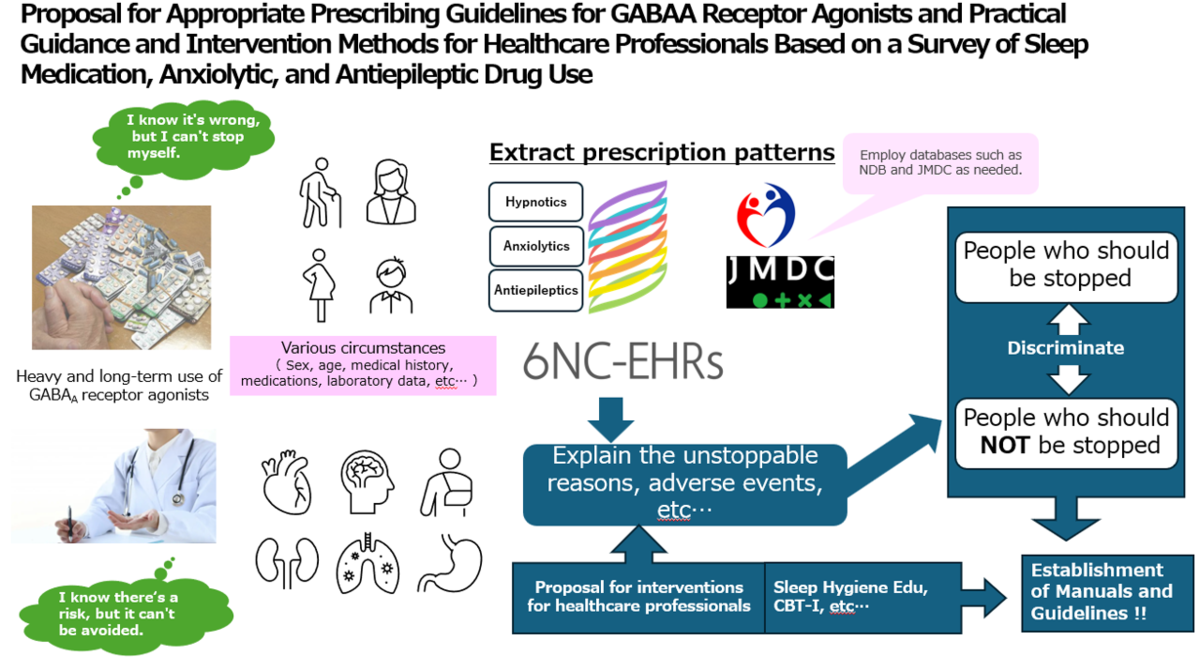
The appropriate use of GABAA receptor agonists, including benzodiazepine hypnotics, is recognized as an international medical issue. Japan is one of the countries with relatively lenient prescription regulations for GABAA receptor agonists. To promote their appropriate use, it is essential to carefully understand the issues faced by prescribing physicians in clinical practice and clearly outline strategies to address them.
According to the insurance claims database of the Health Insurance Association Japan, the new prescription rate for benzodiazepine hypnotics has been gradually declining every year. However, the new prescription rate for non-benzodiazepine hypnotics (Z-drugs) that are GABAA receptor agonists shows a trend of remaining flat to slightly increasing. In addition, among long-term users, benzodiazepine hypnotics still account for the majority. Including Z-drugs, GABAA receptor agonists constitute three-quarters of users. This situation presents common issues for GABAA receptor agonists used as anxiolytics or antiepileptic drugs.
Furthermore, while appropriate sleep hygiene education and cognitive behavioral therapy for insomnia (CBT-I) are effective for the appropriate use of hypnotics, their adoption rates are also insufficient.
The objective of this study is to promote the appropriate use of GABAA receptor agonists, including hypnotics. To achieve this, we will investigate the prescribing practices of GABAA receptor agonists across diverse clinical settings in various medical departments. We will then propose practical guidelines to promote appropriate use, along with sleep hygiene education and intervention methods that can be implemented even by busy healthcare professionals, including nurses and pharmacists.
The prescription practice survey will primarily utilize the NC Integrated Electronic Health Record Database (6NC-EHRs) operated by the Japan Health Research Promotion Bureau (JH). We plan to utilize the NDB datebase of the Ministry of Health, Labour and Welfare, Japan and various databases operated by JMDC as needed.
Image
Perspectives
Specifying the conditions and states where GABAA receptor agonists are most urgently needed--primarily for insomnia, anxiety, and epilepsy treatment--will promote their appropriate use. This will help establish more effective and safer treatment strategies in society. It will also contribute to enhancing systems that enable healthcare professionals to provide high-quality care while reducing their workload.
Comments from principal researcher
Kenichi kuriyama
(Director, Department of Sleep-Wake Disorders, National Institute of Mental Health, National Center of Neurology and Psychiatry)
The fundamental principle of medical care is to prescribe medications by weighing the potential benefits (efficacy) against possible harms (side effects), while considering each patient's individual characteristics and circumstances to determine the most appropriate drug. GABAA receptor agonists have a well-established efficacy profile, but they are also associated with various potential side effects. We believe the appropriate use of GABAA receptor agonists involves conducting more detailed investigations into cases where the benefits outweigh the risks when selecting this medication. It also entails clearly defining the circumstances and situations where the use of this medication is unavoidable and implementing strategies to address these situations.
Shared Researchers
National Center of Neurology and Psychiatry
Department of Pathology of Mental Diseases, National Institute of Mental Health, Ryota Hashimoto
Department of Epileptology, National Center of Neurology and Psychiatry Hospital, Go Taniguchi
National Center for Geriatrics and Gerontology
Department of Education and Innovation Training for Pharmacy, Fumihiro Mizokami
Japan Institute for Health Security
Department of Psychosomatic Medicine, Center Hospital of National Center for Global Health and Medicine
National Cancer Center
Department of Psycho-Oncology, National Cancer Center Hospital
National Cerebral and Cardiovascular Center
Department of Psychiatry, National Cerebral and Cardiovascular Center Hospital