
Medical Research on Aging-Related Disorders Associated with Acquired Chromosomal Changes
Abstract
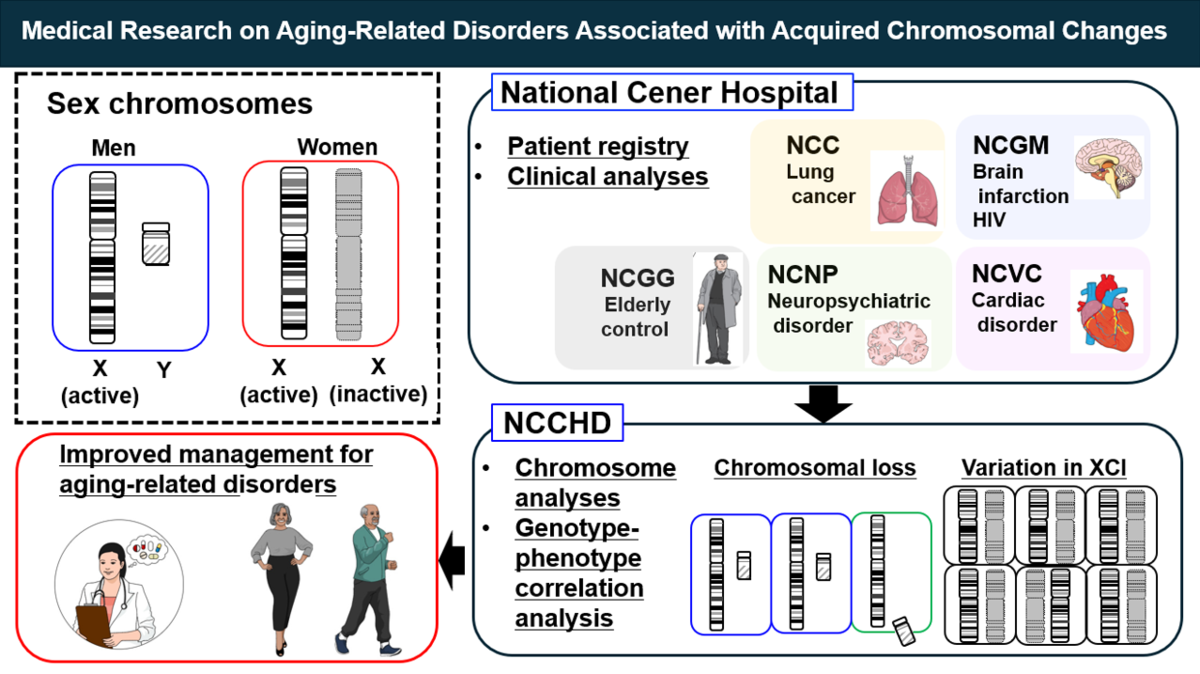
This project aims to clarify the possible association between aging-related diseases and sex chromosomal changes. It was widely believed that all male cells contain one X chromosome and one Y chromosome, while all female cells contain two X chromosomes. Furthermore, X chromosome inactivation (XCI) was assumed to be a simple phenomenon that equally occurs in all female cells. However, recent studies have revealed that the number of sex chromosomes can change across life stages. In particular, Y chromosomes are frequently lost in somatic cells of elderly men. Furthermore, it has been found that the effectiveness of XCI varies among females.
The present study investigates how these sex chromosome changes affect health. Specifically, we examine the number and structure of sex chromosomes in patients with various aging-related diseases, such as lung cancer, dementia, Alzheimer's disease, and heart failure, who visited the National Center Hospitals. This project utilizes novel techniques, including next-generation sequencing. We will compare the results of patients with those of age-matched unaffected individuals. Furthermore, we analyze the effects of environmental factors such as smoking and obesity on sex chromosome changes.
Image
Perspectives
- This study will enable the prediction of future disease risk from the current condition of sex chromosomes. These results serve to establish management protocols to reduce the risk of age-related diseases.
- The results of this research will contribute to elucidating the molecular causes of aging-related diseases.
Comments from principal researcher
Maki Fukami
(Department of Molecular Endocrinology, National Center for Child Health and Development)

Accumulating evidence suggests that sex chromosomal changes can affect human health. Our study aims to elucidate the association between sex chromosome changes and aging-related diseases. The results of this research contribute to the development of preventive methods for various aging-related diseases.
Shared Researchers
National Center for Child Health and Development
Department of Molecular Endocrinology, Kazuhisa Akiba
National Cancer Center
Division of Genome Biology, Kouya Shiraishi
National Cerebral and Cardiovascular Center
Department of Genomic Medicine, Yoshihiro Asano
National Center for Geriatrics and Gerontology
Medical Genome Center, Kouichi Ozaki
National Center for Global Health and Medicine
Department of Neurosurgery, Masato Inoue Department of Neurosurgery, Masato Inoue
AIDS Clinical Center, Kiyoto Tsuchiya
National Center for Neurology and Psychiatry
Medical Genome Center, Sumiko Yoshida